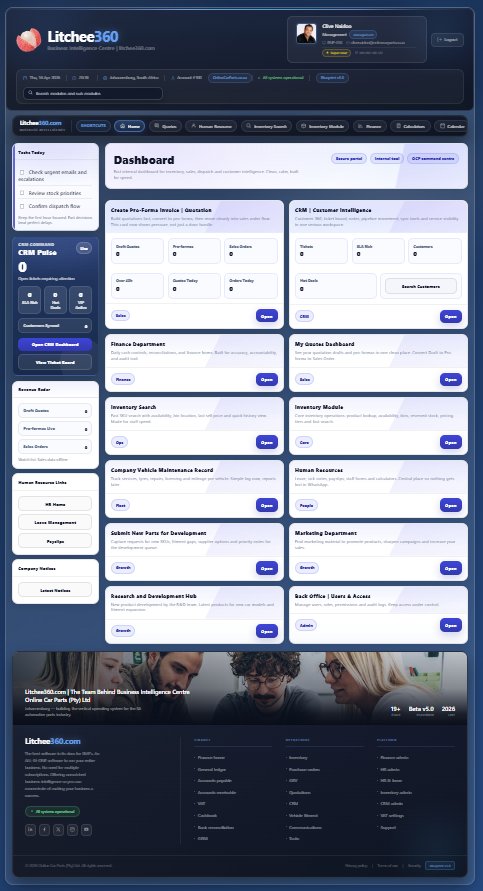
This is not a generic ERP with a vehicle lookup bolted on. Litchee360 was built by someone who ran an automotive parts business and found that no existing platform understood what a GRV was, what GRNI meant, or why fitment-aware quoting matters.
Your GRV confirmations are not posting to your ledger. Your GRNI is either missing or wrong. Your creditors are overstated because the supplier invoice posted directly to Creditors Control without clearing a GRNI entry.
GRV confirmation atomically creates a GRNI liability and updates stock in one transaction. When the supplier invoice posts, it clears GRNI and credits Creditors Control. Creditors are never overstated. The books and the warehouse always match.
You quote by memory or by looking up parts manually. You do not see GP margin until the end of the month, if at all. You price on instinct and discover the margin problem in the income statement three weeks later.
Every quote line shows GP margin in real time, resolved against actual cost. Vehicle fitment lookup is built into the quoting screen. You see the margin before you send the quote. You price on data, not instinct.
Your VAT201 takes two days every two months because your system does not write VAT records at transaction time. You are calculating VAT from invoice totals and hoping the rounding reconciles to the journal.
Every taxable transaction writes a dedicated VAT record at posting time. Line-level calculation, correct rounding. The VAT201 supporting data exports directly from the platform. Not two days. Not two hours. Ready when you need it.
Vehicle intelligence exists in someone's head or a spreadsheet. You do not know which vehicle platforms are most profitable, which engine codes move the most stock, or which customers are worth the most margin.
The Vehicle Intelligence Centre delivers fitment lookup, engine code search across manufacturer boundaries, and profitability analytics by make, model, and platform. No other SME platform does this natively. This is your competitive advantage made visible.
Every step in the workflow is connected. No manual entry between systems. No reconciliation at the end of the month.
Purchasing creates a PO against the supplier. Lines reference inventory items with expected cost and quantity. No GL posting at this stage — a PO is a commitment, not a liability.
No GL impactReceiving captures the GRV against the PO. Quantities and costs recorded per line. Status is draft until confirmed.
Draft — no GL impact yetConfirming the GRV runs a single atomic database transaction: stock balances updated, GRNI liability posted to the ledger. If either the stock update or the journal fails, both roll back. No partial state. No manual reconciliation required.
DR Inventory Control / CR GRNIAP clerk captures the supplier invoice matched to the GRV. The system detects the GRNI link and routes posting through the GRNI flow automatically.
Draft — pending postPosting the supplier invoice clears the GRNI liability and credits Creditors Control. VAT Input posts to the VAT ledger at line level. Your creditors are now correctly stated.
DR GRNI + VAT Input / CR Creditors ControlAP processes the payment. The journal posts automatically: DR Creditors Control, CR Main Bank. The payment is allocated against the invoice, updating the outstanding balance and the AP ageing report instantly.
DR Creditors Control / CR Main BankFitment lookup by make, model, variant, and year. Engine code search across manufacturer boundaries — codes are not locked to a single brand. Vehicle profitability analytics.
Quote by vehicle. Every line item resolves against fitment data. GP margin visible per line in real time before you send. WhatsApp and SMS built in. PDF generated on demand.
The complete supplier delivery-to-payment workflow with atomic stock and finance posting. GRNI exists in the chart of accounts from day one. Creditors never overstated.
Search by part number, description, supplier reference, or vehicle fitment. Real-time stock availability per warehouse. Last cost and average cost tracked per item.
PAYE, UIF, SDL, ETI, IRP5, and EMP201 — handled natively. Not a third-party integration that breaks every March when SARS updates tax tables.
When a part is not in the catalogue, submit it for development directly from the quote line. Track new part development from request through to catalogue entry.
You buy parts from suppliers, hold stock, and sell to workshops, fitment centres, and the public. Your business lives on GRVs, fitment data, and margin management.
You fit parts as well as sell them. Your quoting needs to be vehicle-specific and your stock needs to reconcile to your books after every job.
You import from multiple suppliers, land goods at different costs, and distribute to a dealer or retail network. You need GRNI, landed cost visibility, and AP that works at volume.
You have outgrown your current setup and know it. You want real accounting, real inventory, and one platform that does not require a spreadsheet to bridge the gaps.
The Litchee360 engine — double-entry accounting, inventory, purchasing, GRV, and payroll — serves any business that buys stock and sells it. These verticals are on the roadmap.
High-volume SKU counts, supplier credit management, branch stock transfers, and trade account management.
Cable pricing by metre, project quoting, contractor account management, and high-value inventory control.
Lot and expiry tracking, medical aid billing reference, consumable replenishment, and SAHPRA compliance support.
Because it was. 30 days free. No card. No setup fee. No consultant required.